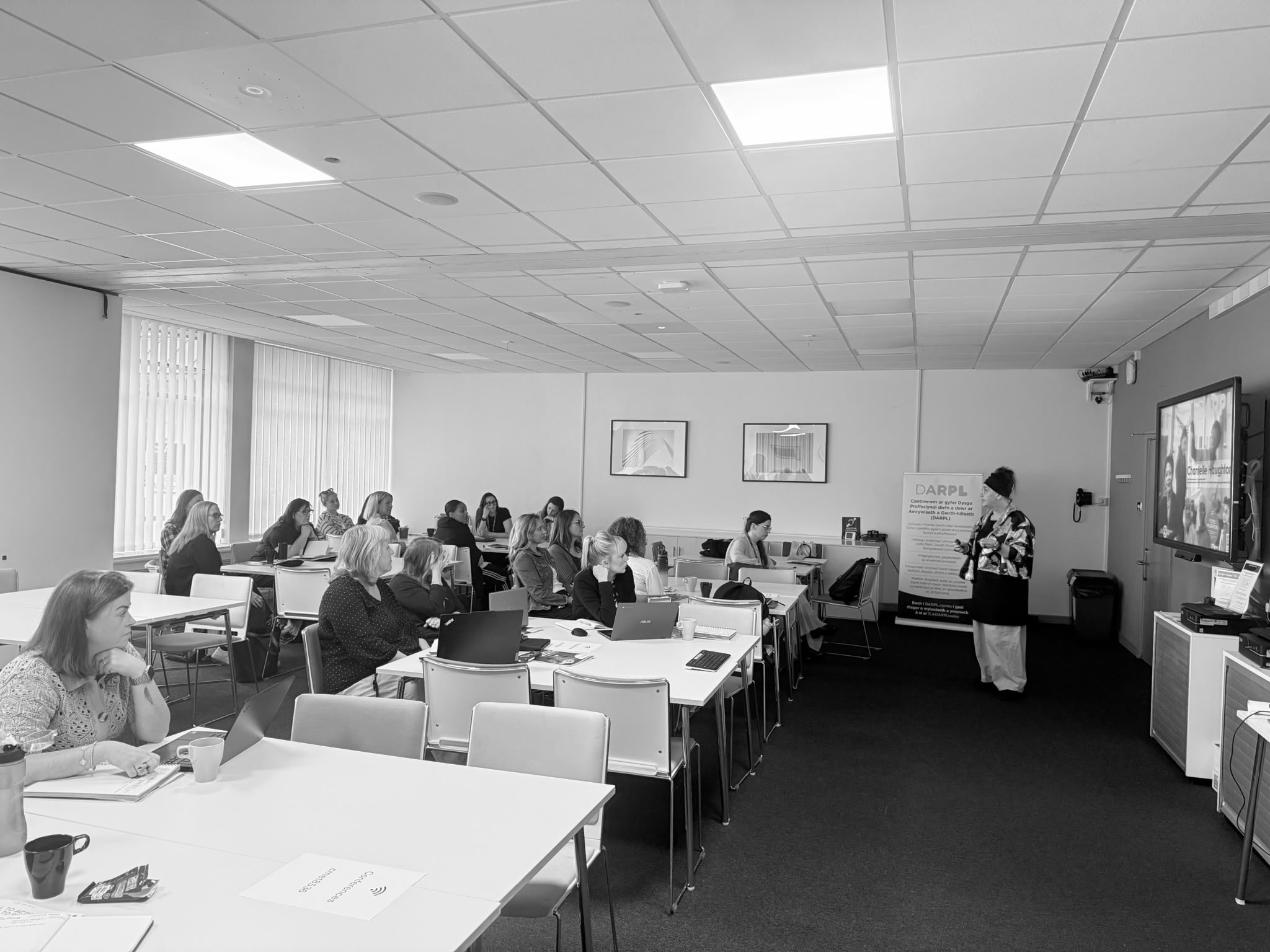
The DARPL Enhanced Leadership Series (ELS) stopped me in my tracks, made me sit, sometimes uncomfortably, with truths, and reflect on the role I play both personally and professionally in shaping and influencing a better world. Of course, it isn’t enough just to reflect – this is generally a passive action and the busyness of our mind, and our work can often mean we quickly move on to the ‘next thing’, with a seeming inability to be present in the moment and commit to making any meaningful change.
Attending the DARPL ELS series, I was struck by a collective energy and care and a true community-of-practice, which I don’t believe was just because we were all educators. Yes, it was great to see a commitment to anti-racism spanning early years right the way through to further education, but it was more than this, there was a shared values base and a commitment to give time both in sessions and in deep learning and implementation and steered reading outside of the structured ELS sessions to learn, improve practice and be changemakers. The collective learning experience within ELS was transformational.
I feel incredibly fortunate to work in an organisation where values are more than just words on a wall or on a website. Values create a sense of community and ultimately, a place of belonging, where people are accountable for their actions and words. During our DARPL ELS third day, facilitated by Kwame Boateng, he talked about people as ‘pattern masters’, who can change the tapestry, changing something now to impact the future – wow. This really resonated with me, thinking about both the privilege and weight of responsibility we have working in education, to nurture and shape minds and to make a difference. This isn’t about our role or title within an organisation, but the daily interactions, opportunities and responsibility we all have. Interactions and language have a profound impact, often without us realising. I often reflect on moments in my own journey which, looking back, can feel uncomfortable, but they have developed me and undoubtedly helped me to navigate future challenges and opportunities, hopefully for the better.
I acknowledge that I am in a role where shaping organisational development and professional learning priorities is a core part of my remit. We have committed a number of whole college learning days to building our approach and expectations around becoming an anti-racist organisation. We have been lucky enough to have some great input and honest lived insights from speakers including Jeffrey Boakye (prolific author), Professor Jason Arday, Gulwali Passarlay, Professor Uzo Iwobi OBE (who is also a fellow of the College), Rachel Clarke (from CMet, DARPL and APEX) and Connor Allen (poet and former Children’s Laureate of Wales). Importantly, this work has extended into engagement with our students too.
Despite some excellent professional learning opportunities, I have been increasingly reflecting on the impact of ‘training’ versus personal accountability to do the right thing – it’s about human kindness after all. Training is just one piece of the tapestry, perhaps elements of the instruction manual, if you will, but fundamentally, we must then move into action. In this mindset, both personal and professional learning needs to be continuous, sustained, supported and challenging.
Some of our College actions, one example is as a result undertaking the DARPL Enhanced Leadership Series. For example, drawing on the DARPL Eradication Guidance https://darpl.org/wp-content/uploads/2024/07/DARPL-Eradicating-Racism-Guide_ENGLISH.pdf
We have developed flow-chart which clearly outlines our approach to handling racist incidents / disclosures, visibly communicating procedures management for both staff and students. This creates important clarity, along with expectations, which are aligned to our organisational values. Boakye (2022) and Davis and Haughton (2023) illuminate the hurt and pain that racism and lack of appropriate action causes and therefore the importance of it being dealt with as a core safeguarding issue.
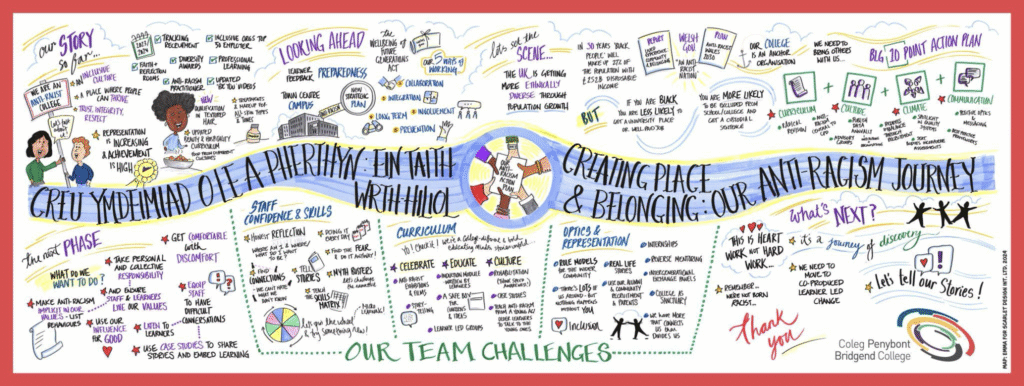
We also have a developed a more detailed anti-racism action plan at Bridgend College, aligned to the Welsh Government Anti-Racism Action Plan, which has included us appointing an anti-racism curriculum practitioner to support all of our curriculum areas to develop their pedagogy and teaching resources. One great examples of this work in action has been our Hair and Beauty curriculum area working with an awarding organisation to design and accredit a module on textured hair, enabling our students to broaden their skills and knowledge as they prepare for their future careers. In our most recent review of our action plan, we brought together students, staff and governors to reflect on our progress to date and to identify our key priorities as we look ahead – you can see the overview captured of the day below.
Irrespective of your role within your learning organisation, remember three things:
- Anti-racist focused professional learning is more than ‘just training’ or what your organisation plans on paper – it starts with you. Think about who you connect with, the books you read or the podcasts you listen. Reflect, learn, but most importantly, make intentional change.
- Human kindness is free and it’s contagious – people make change happen.
- Engage with DARPL provision, resources and community of practice opportunities.
All leaders and your teams, please consider going on the DARPL Enhanced Leadership Series (ELS) to build your work and your community of practice. If you’ d like to find out more about the DARPL ELS or to book your place, follow this link: https://darpl.org/community-of-practice/enhanced-leadership-series/
Reference:
Boakye, J. (2022). I Heard What You Said. Pan Macmillan.
Davis, S and Haughton, C (2023) Gwent Safeguarding Board Report. Gwent: GSB