

Racism can only be tackled when the public starts acknowledging that racial discrimination exists within our own society. Various reports such as Race Alliance Wales’s ‘Show Us You Care’ (2021) and the race equality review carried out by Wales Centre for Public Policy (Skeels, 2022) evidence the undeniable persistence of racism within Welsh society. Racial practices are often hard to notice as they have become ingrained into our societal systems, rules and regulations (West, Greenland & Laar, 2021). So, our way of seeing and thinking is often (un)consciously shaped as a result of our adaptation to the system.
Every person living in Wales deserves ‘a society that enables people to fulfil their potential no matter what their background or circumstances’ (Well-being of Future Generations (Wales) Act, 2015). In terms of race equality, the Welsh Government has taken a proactive approach to rid Wales of racism through their introduction of the Anti-Racist Wales Action Plan (2021) (ARWAP), moving towards their goal for ‘an anti-racist nation by 2030’ (Welsh Government, 2022, p. 8). One area they have decided to target is the educational system. And quite rightly so, as this is where socialization of the new generation starts. Tackling racism within the educational system will lay good foundations for achieving racial equity in future generations so that every person in Wales gets a chance to live a fulfilling life. In this blog post, I explore some of the challenges of realising an anti-racist Wales, especially when considering often ‘hidden’ forms of racism in education, such as Islamophobia.
What is Classed as Racism?
Racial categories appear to be defined using ideas that have been passed on from generation to generation, stemming from the colonial yesteryears (West, Greenland & Laar, 2021). Over time, these ideas have become entrenched within the structures and practices of society.
A study by Dr Greenland and colleagues (2022) argues that in everyday situations, it is the individual’s draw on ‘Definitional Boundaries of Discriminations’ (DBDs) that determines what an individual may decide as racial discrimination. These boundaries can be broad or narrow; the narrower the DBDs, the less likely it is that an individual would identify the different types of racial discrimination. For example, sometimes, well-meaning people with narrow DBDs say that they choose not to ‘see colour’. But unfortunately, this supposedly moderate stance has the possibility of being quite detrimental. To be ‘colour blind’ is to choose not to recognise the presence of racism within society; it is to assume that the playing field is level for everyone. It leads to the overlooking of racial unfairness and damagingly, it authorises racial prejudice to continue within society.
To ensure everyone has the opportunity for a better future, every member of society needs to make an active effort to notice and stop the different ways that racism rears its ugly head within society.
Challenges Faced by Young People and Parents
Children and young people spend almost half of their waking hours in school. Their experiences in school settings have a big impact upon how they see themselves. As young people, they are trying to figure out their identities. They are trying to comprehend how they fit in with their surroundings; often struggling with feeling left out because of their gender, ethnicity or even their cultural or religious background (DeMille, 2023a). All too often Muslim pupils find themselves having to make some difficult decisions for themselves, more so when school staff are oblivious to their arduous task of attempting to balance their ‘Britishness’ with their ‘Muslimness’ (Miah, 2015).
One example of such difficulties Muslim pupils and their parents can experience can be seen in this account from a mother of a female Muslim pupil. At the age of 13, her daughter decided to make a more concerted effort with her religious obligations. She focused on praying, being modest in her choice of clothing (otherwise known as ‘hijab’), and decided, for the first time, to fast the whole Islamic month of Ramadan. Unfortunately, the pupil’s eagerness was not met with enthusiasm at school. Prior to Ramadan, the school had sent out letters asking parents to only allow children to fast on weekends, stipulating that local imams have said that children under 14 need not observe fasting. Her mother took the letter with a pinch of salt; in Islam, once a child reaches adolescence, they are considered mature enough to make their own religious choices, including their right to fast during Ramadan.
Islamic months follow a lunar calendar and in that particular year, Ramadan fell on a very hot, long June. The first few days were particularly challenging, but her daughter bravely pushed on, persevering with her daily life, going to school every day. Her first Physical Education (PE) lesson of that Ramadan is where she encountered her first obstacle. That particular lesson was the 100-metre sprint. Despite being shy and timid, her daughter plucked up the courage to inform her teacher she was fasting. The teacher responded saying that she was not required to fast, especially since she was under the age of 14. Nevertheless, she was required to participate in her PE lesson. The daughter joined in with the lesson, but also chose to continue to fast for the rest of the school day. She later recollected to her mother how challenging the day had become. Her daughter had found it particularly difficult to focus on subsequent lessons, feeling mainly tired and thirsty. Perplexed, her mother asked her why she continued fasting under such circumstances. Her daughter’s reply surprised her, she was determined not to break her fast; she would not allow the teacher to make that choice for her. Seeing her daughter’s determination, the mother wrote a note requesting that her fasting daughter be given a less strenuous task for the following PE lesson.
Later that morning, the mother received a phone call from her upset daughter. She went straight to school to personally appeal to the teachers to respect her daughter’s wishes. The mother recalls feeling overwhelmingly intimidated as she attempted to explain to a panel of senior management staff members in the Headteacher’s office, reasons why her daughter’s wishes ought to be respected. The school leaders were unwilling to accept her request to facilitate less strenuous activities for the month of Ramadan. The mother simply could not find a way to move past their statement: ‘We are not a faith school and do not haveto adhere to faith-based requests’. After an hour of debating, the Headteacher finally accepted that an alternative should be made for the daughter only. In the knowledge that there was a large number of Muslim pupils attending the school, the mother urged that the same courtesy be extended to other pupils choosing to fast, explaining that not everyone’s parents had the courage, confidence or language skills to speak to the Headteacher. But unsurprisingly, her plea fell on deaf ears. Once again, she was reminded that they were not a faith school and did not have to accommodate this request.
Subduing Children’s Rights
Every child in Wales has access to a set of rights. The United Nations Convention on the Rights of the Child (2022) (UNCRC) was adopted by Welsh Government in 2004 and includes 42 rights and articles which protect children aged 18 and under. Each of these rights carry equal significance. Yet, when it comes to children enacting their rights in school, some are having to compromise their religious right (Article 14) over their educational right (Article 28). It appears that those with educational authority are making the choices, choosing certain rights over and at the expense of other equally important rights of the child. So, despite the fairness provided to them by the UNCRC, certain children will remain disadvantaged within the educational system (Gov.uk, 2023). Thinking about the experience faced by the 13 year old Muslim pupil at school, it raises questions such as: how are children’s rights protected when thinking about ‘hidden’ racism and discrimination?
Hidden Racism
The playing field for ethnic minority pupils is by no means level. On top of that, due to the difficult to recognise nature of racism, its effect is amplified for certain pupils.
The school leaders’ actions to not allow the daughter to express part of her identity, was clearly not considered by them as discriminating behaviour (Greenland et al., 2018). They were oblivious to the fact that as figures of authority, their actions sent the message that in order to fit in to the school system, the daughter had to conceal and modify parts of herself, such as her religious choices.
It’s encouraging to see that within ARWAP, the Welsh Government have identified the crossover of religion with racism. Applaudably, they have made a point to address the prejudice and inequalities faced by Muslims in Wales. They have accepted ‘Islamophobia’ as racial discrimination towards a group of people, because of their religious identities (The All Party Parliamentary Group on British Muslims (2017); Runneymede Trust (2019).
The school leaders were not entirely at fault for not noticing their actions were discriminatory against the pupil and her mother. It is difficult to notice something unless people know what it is they are looking for. This means that in order to totally eradicate racism and realise an anti-racist Wales, even subtle forms of racism need to be identified and tackled.
Fit For Purpose Policies?
School leaders and staff are some of the most important people who can make a difference in minimising the effect of racism within the educational system. Being on the front line, they are the ones shaping the future generations; it is their values that can control what is and is not considered important. They are in the best position to notice and call out any potential acts of racism within everyday school life.
An equally important role for school leaders will be to produce an effective Equality and Diversity policy. Some policies do not do much. Simply stating the importance of diversity and antiracism in policies is not the same as tackling the problem of racism within schools. Worryingly, schools that carelessly adopt policies, simply because they tick the ‘Race work done’ box can hide potential racism within schools, while also making it difficult to make claims of racism. On the other hand, a good policy has the potential to identify racism. It would allude to ways of resolving problems of racism, ensuring there is a system in place to guide pupils, teachers, and parents in order to accomplish anti-racism.
It goes without saying that such policies have to be easy to understand and fit for purpose (Ahmed, 2007), they have to be effective in trying to spot and eradicate the problem of racism in schools.
The Way Forward
To tackle racism head on, we need to face the uncomfortable truth, that racism exists within Welsh society. Ideas on race have been passed on over generations – constantly changing and evolving – becoming so ingrained within society that they are almost unnoticeable. The complex and multi-layered nature of racism means that racism harms different people in different ways.
As the Ethnic Minorities & Youth Support Team (EYST)’s Racism in Education forum (Bahadur et al., 2023) highlight a large percentage of pupils face problems in schools as a result of their ethnic, cultural or religious identity. What makes it worse is that pupils are actively discouraged from reporting such incidents. Sometimes this was because parents felt their children would be targeted as troublemakers by school. In other cases, it was because of negative experiences felt by pupils when reporting incidents, where the school took no action, almost ignoring them. Worse still, some pupils reported feeling as if they were being punished by their school for highlighting such incidents. So, it comes as no surprise that some pupils feel compelled to handle their problems of racist bullying themselves. Unfortunately, this course of action almost always does not lead to any resolve for the pupil. Rather, they are punished by school for handling matters in a negative way. EYST have recently launched a Right to Education project (R2E) as a way of alleviating issues and disputes faced by pupils in school. This includes issues such as school exclusions, which are often a symptom of young people taking problems faced from racist bullying into their own hands.
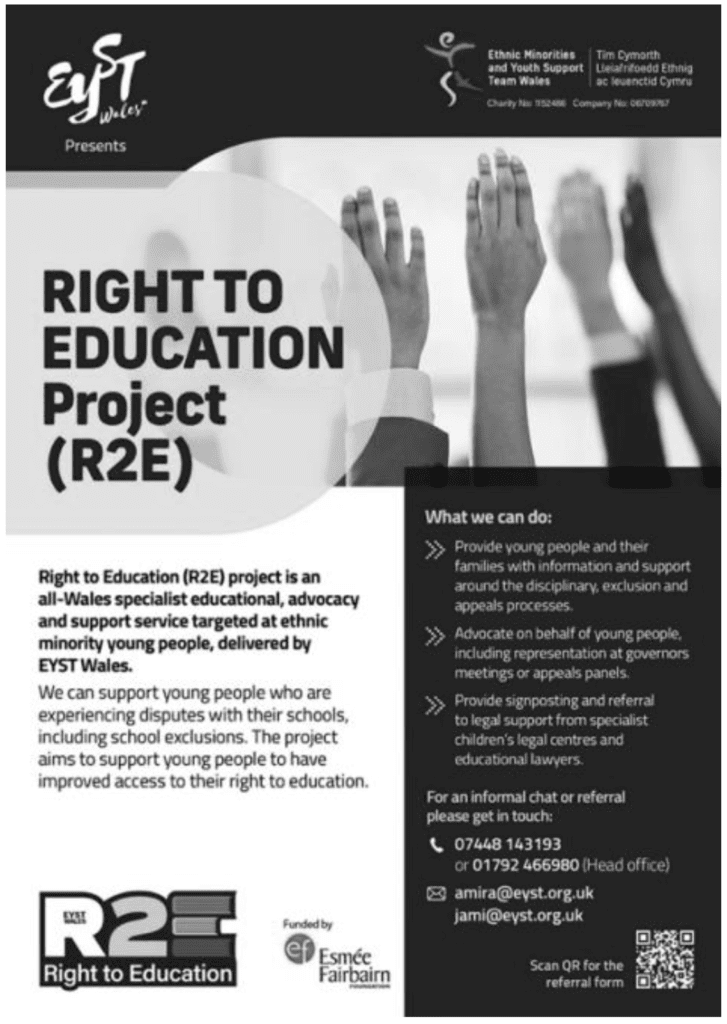
EYST’s ‘Right to Education’ advocacy and support service.
The incident of the mother and her daughter’s experience in school is just one of many examples of how racism can appear within the education system. It is an example of how racism lies unseen within school structures, policies, procedures and within school’s leadership team. Racism, in all its forms, wears down young people’s trust in the educational system and its authorities. It usurps the rights given to them by the UNCRC, thereby limiting their freedom in school.
It is therefore everyone’s responsibility to stay alert and know what signs to look out for. As members of the public, we each have a responsibility to take active steps to minimise the challenges faced by ethnic minority children and young people. We need to ensure that those in charge are doing their part well and where necessary, hold them to account in order that we may achieve a Wales where every member can live a free and fulfilling life.
References:
Ahmed, S. 2007. ‘You end up doing the document rather than doing the doing’: Diversity, race equality and the politics of documentation. Ethnic and racial studies 30(4), pp. 590-609.
Anti-racist Wales Action Plan (2021) GOV.WALES. Crown Copyright. Available at: https://gov.wales/anti-racist-wales-action-plan (Accessed: December 12, 2022). Anti-racist Wales Action Plan | GOV.WALES
APPG on British Muslims reports (2017), APPG on British Muslims. Available at: https://appgbritishmuslims.org/publications (Accessed: 19 August 2023).
Bahadur, S., Akbar, T. and Connolly, G. (2023) “racism in education 2021: Where are we now?” forum – EYST, Ethnic Minorities & Youth Support Team. Available at: https://eyst.org.uk/assets/racism-in-education-2021-where-are-we-now-forum-notes.pdf (Accessed: 27 August 2023).
DeMille, S. (2023a) Teenage Identity Crisis: Causes, problems and common behaviours, ThreePeaks Ascent Residential Centre. Available at: https://threepeakstreatment.com/ /residential-treatment-for- teens/teenage-identity/crisis-issues/ (Accessed 27 August 2023)
Future Generations and Well-being (Wales) Act. (2015) “A More Equal Wales”, Available at: https://www.futuregenerations.wales/a-more-equal-wales/
Gov.uk (2023) Education, skills and training, GOV.UK Ethnicity facts and figures. Available at:
https://www.ethnicity-facts-figures.service.gov.uk/education-skills-and-training (Accessed: 19 August 2023).
Greenland K, Andreouli E, Augoustinos M, Taulke-Johnson R. (2018) ‘What Constitutes ‘Discrimination’ in Everyday Talk? Argumentative Lines and the Social Representations of Discrimination’, Journal of Language and Social Psychology, 37(5), pp. 541–561.
Greenland, K., West, K. and van Laar, C. (2022) ‘Definitional boundaries of discrimination: Tools for deciding what constitutes discrimination (and what doesn’t)’, Journal of Applied Social Psychology, 52(10), pp. 945–964. doi:10.1111/jasp.12902.
Miah, S., 2015. Muslims, Schooling and the Question of Self-segregation. Springer
Race Alliance Wales. (2021). Show Us You Care. Available at: https://racealliance.wales/research/
[Accessed 14 August 2023].
Skeels, A. (2022) Evidence and an anti-racist Wales, Wales Centre for Public Policy. Available at:
https://www.wcpp.org.uk/commentary/evidence-and-an-anti-racist-wales/ (Accessed: 19 August 2023).
The Runnymede Trust: Open Letter on Islamophobia (2019) The Runnymede Trust | Open Letter on
Islamophobia. Available at: https://www.runnymedetrust.org/blog/open-letter-on-islamophobia (Accessed: 19 August 2023).
United Nations Convention on the rights of the child (2022) UNICEF UK. Available at:
https://www.unicef.org.uk/what-we-do/un-convention-child-rights/ (Accessed: 19 August 2023).
West, K., Greenland, K. and Laar, C. (2021) ‘Implicit racism, colour blindness, and narrow definitions of discrimination: Why some White people prefer ‘All Lives Matter’ to ‘Black Lives Matter’’, British Journal of Social Psychology, 60(4), pp.1136-1153.
By Ameena Asad
Ameena Asad is a postgraduate research student at Cardiff University. Her PhD, in collaboration with EYST Wales, looks at anti-racism in education, with a focus on the policy-implementation gap in schools in Wales. She is also a volunteer ambassador of EYST’s Right to Education (R2E) school exclusions project. If you want to find out more about her research, please get in touch: AsadA@cardiff.ac.uk