
Why we should bid farewell to George and Lennie and welcome Marguerite into our classrooms.
For decades, Steinbeck’s infamous novella has retained its strong, archaic grip on GCSE students and teachers across the country. Despite Lennie’s endearing obsession with the rabbits, the historical insight the novel provides, and its initial critical reception: we cannot continue exposing our learners to its inherent inappropriateness. In the summer of 2022, we as an English Department in Ysgol Gyfun Gymraeg Glantaf decided not to continue with our teaching of ‘Of Mice and Men’. I was relieved: reading the novel aloud to a class was always an uncomfortable experience. Regardless of my omission of reading racial slurs and misogynistic terms, the words remain on the paper and remain in our learners’ minds. Questions would arise, or a guffaw would occur and some students were horrified at the topics and themes discussed. Of course, ‘Of Mice and Men’ was useful in teaching us and our learners about life in the 1930s for those greatly impacted by The Great Depression. The ranch’s inhabitants include physically and mentally disabled people, Black people, and suffering people; all in search of freedom and achieving the ultimate American Dream. However, what are we truly learning about racism, ableism, sexism, and general prejudice from the voice of a privileged, able, affluent white man?
So where do we go from here?
The GCSE English Literature Specification does not provide a wide variety of literature to choose from, but we do have the choice of the awe-inspiring Angelou. ‘I Know Why the Caged Bird Sings’, published in 1969 is an autobiographical novel detailing the hardships and reality faced by Marguerite Annie Johnson. From going to the dentist, graduating, enduring sexual abuse from her mother’s boyfriend, questioning her sexuality, and of course, facing the implicit racism of Stamps and beyond; Angelou’s personal, heart-breaking chronicles are monumental, teaching us: a modern audience, important lessons.
Our decision was made and our endeavours into ‘Caged Bird’ began.
AO4 evermore
IKWTCBS context/poem lesson
The AO4 strand of the Literature mark scheme bears great importance as it requires learners to relate texts to their social, cultural, and historical contexts. Reflecting on the context is extremely significant as it allows learners to truly understand why authors present themes and characters in the way that they do.
Tasked with providing a Year 9 class with an initial introduction to the GCSE Unseen Poetry section, I decided to use this opportunity to unravel some of the AO4 convoluted wire. When introducing the context of ‘I Know Why The Caged Bird Sings’, I decided to consider Angelou’s inspiration for her novel: Paul Laurence Dunbar. Angelou references Dunbar in the novel and says that she saves her ‘young and
loyal passion’ for him, even though she is ‘in love with Shakespeare’! Dunbar’s poem: ‘Sympathy’ tells the tale of a caged bird desperate to escape the barriers of its prison, it longs to be amid the ‘upland slopes’ and be on the ‘bough-a-swing’; however, in its cage, it remains. Angelou relates to this feeling of being confined by societal barriers thus feeling ‘caged’ and explores this concept throughout ‘I Know Why The Caged Bird Sings’.
When introducing this poem to the class, we needed to build up our knowledge and understanding of contextual knowledge before studying the stanzas. To begin, I thought it would be useful for the learners to consolidate their understanding of the word ‘Sympathy’ and allowed them the freedom to note any connotations of the word. Once the connotations were shared, I provided them with visuals to further reinforce the ideas demonstrated.
Once ‘Sympathy’ was understood, we turned our focus to the poet. On the slide, I included a short paragraph with certain words highlighted to focus their attention on them. By drawing the learners’ attention to ‘enslaved’, ‘emancipation’ and ‘first African American’, our contextual lens was narrowed thus hopefully ensuring a better grasp on the message of the poem.
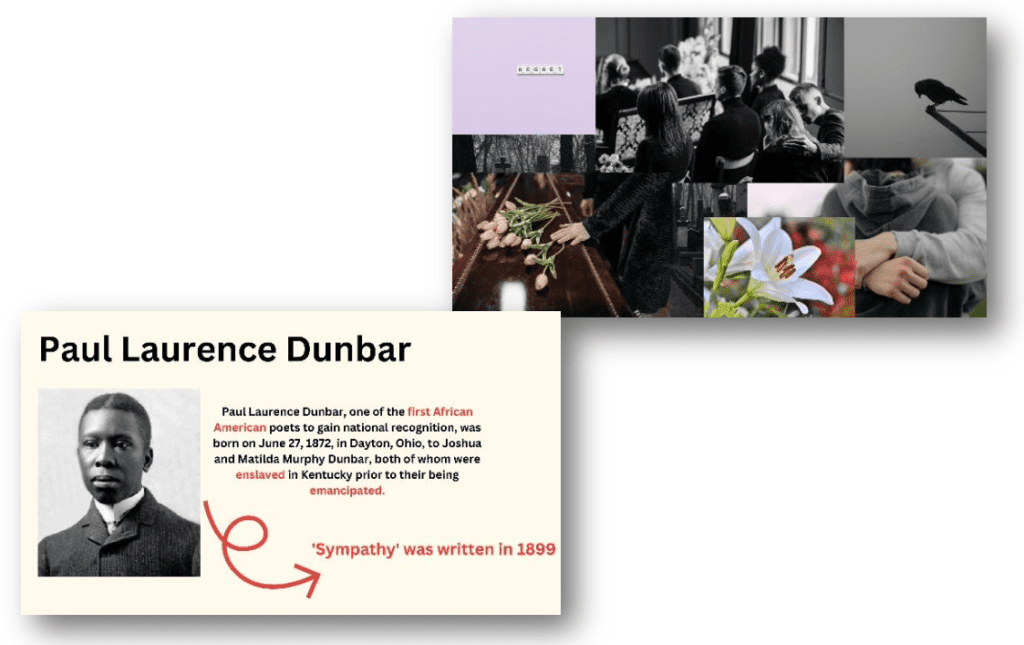
We then proceeded in tackling two of the stanzas in groups. The groups were to discuss and attempt to decipher the meanings of the stanzas using the contextual knowledge built. I highlighted some potentially difficult terms from the stanzas and also included some visual aids to assist in the analysis. The lesson was very simple and I felt as though it was a straightforward yet significant gateway into understanding the wider context of Angelou’s autobiography.
Lessons Learnt?
In 2022, the WJEC English Literature Higher Tier Exam asked candidates:
‘I knew I knew very little, but I was certain that the things I had yet to learn wouldn’t be taught to me at George Washington High School.’’ What important lessons do you think Maya learns outside of school as she grows up?
Of course, we can discuss how Maya learns about the prevailing prejudice of the time and how her resilience and defiance build as a result of the hardships suffered outside of the classroom. However, we can also learn from the lessons our protagonist learns. We experience the trials and times of Angelou and her family through her eyes, in her shoes. It allows us to get merely a glimpse of the oppression she suffered; we begin to understand and view the barriers of her ‘cage’; her gender, race, social status, and characteristics. Undoubtedly, it is a matter of fact that we and our learners can develop sincere empathy for Angelou, and thus by the study of this novel, we are hopefully encouraging learners to always act with compassion and kindness for others. As the Curriculum for Wales states: in developing and modelling empathy, learners should be supported to become active citizens who engage pro- socially with different contexts.
Steinbeck’s novel of course allows us to empathise with certain characters however the crucial difference here is perspective. We learn about the authentic tribulations of a Black girl growing up in Arkansas and how she deals with the precarious challenges thrown at her. Her words are important in understanding how there are ‘Caged Birds’ all around us and we should all learn to be social aviculturists!
Gwenno Haf Evans