Where Am I Coming From? – My Back Story
In the early 2000s, I pursued a master’s in education, with a module focusing on Educational Inclusion: A Focus on Education for Racial Equality. At the time, there was significant attention on racial equality, largely driven by the publication of the Macpherson Report in 1999, which made the groundbreaking acknowledgments of institutional racism. This momentum led to training initiatives and the publication of several useful practical resources and books. However, as is often the case with such movements, the initial flurry of activity gradually faded. Resources were shelved, training was forgotten, and beyond procedures for managing and documenting racist incidents, meaningful progress essentially stalled.
Moreover, much of the responsibility for promoting racial equality generally fell disproportionately on a small group of staff—often those, like me, working with minority ethnic and multi-lingual / EAL learners in schools. These individuals were often in ‘support’ roles, positions that were frequently marginalised and lacked the status or authority needed to drive systemic, school-wide change. Attitudinal racism was pervasive, and microaggressions were an all-too-common reality.
Reflecting on that period, I recently revisited my old assignment on ‘racial equality’, hoping to find evidence of progress over the past two decades. Instead, I was struck by how little had fundamentally changed. The issues I had written about, and the experiences of the learner in my case study, sadly felt just as relevant today. Recent research and reports echoed much of what I had documented years ago, highlighting the persistence of racism despite more than twenty years of societal and institutional efforts. The same barriers—both in systems, policies and personal experiences—remain deeply entrenched.
Fast forward to the present, and we are, in Wales, embracing the concept of developing anti-racist practice. This shift raises a critical question: why does anti-racism seem to hold more promise than racial equality? The answer lies in their fundamental difference.
Racial equality is an end goal, a desired outcome where individuals of all races have equal opportunities and rights. In contrast, and more in tune with the shift in education to considering equity, anti-racism is an active process—a deliberate and ongoing effort to dismantle the structures, policies, and behaviours that uphold racism. It focuses on action, accountability, and systemic change, making the journey itself transformative. It is this emphasis on the process, that holds the potential to create more impactful and lasting change. What follows is a glimpse into my own reflections and thoughts on this critical work.
Embarking on the journey of developing anti-racist thinking and planning has been both immensely thought provoking and unexpectedly challenging. I initially approached this work with the somewhat naïve assumption that my thirty years of experience working with ethnic minority learners had provided me with significant knowledge and insight into this area. However, the process demanded far more deep reflection, continuous learning, and intentional action than I had ever anticipated. It required the courage to confront the reality that racism, in all its forms, is pervasive and deeply embedded in the fabric of our society.
My journey began with the realisation of myself as a ‘white’ person—an identity I had not previously considered. Recognising my own power, privilege, and biases became the essential foundation for my anti-racist work. My personal experiences, through travel, living in the Middle East, navigating professional environments, and encountering moments of discrimination by association, have shaped my perspective on the world. Another aspect of this self-refection was recognising that everyone views the world through their own unique lens, shaped by their individual intersections of identity, privilege, and oppression. Therefore, officers and educators that I work with, may interpret the same set of circumstances or information from vastly different perspectives resulting in varying opinions, outcomes and actions.
Another connected contemplation was that the less exposure ‘white’ individuals have to racial diversity, the more likely they are to interpret the world through a dominant lens, often a “white” one. In the context of education and schools this transcends through to policies, systems, processes and the curriculum. Developing racial literacy and cultural awareness is essential but requires humility, openness, and a willingness to learn from others. For me, this has meant listening to and accepting the stories of day-to-day lived experiences of racism and being aware of and challenging my own ‘subconscious’ assumptions built up through the subliminal messages about race abundant in my upbringing in the 60s and 70s. Essentially, unlearning racism.
Anti-racist work, I suggest, must critically start with individual reflection to ensure a solid foundation, but must then extend to institutions. It requires continuity, consistency and collaboration at every level of the system to ensure that anti-racism is woven into the fabric of education from the very beginning. Anti-racism isn’t just about addressing overt racist behaviours or individual incidents, it’s about understanding and dismantling systemic and structural racism—those invisible systems that perpetuate inequality. It also means confronting subtler forms of harm, like microaggressions and problematic language, which can erode a sense of belonging for marginalised groups over time.
Professional learning is a vital springboard, but who delivers it and whose voices are central to it matters immensely. Anti-racist professional learning led by individuals from global majority communities—those with lived experience—is far more impactful. Working with DARPL has enabled this opportunity further in my work and across Wales. Voices with lived experiences carry authenticity, depth, and the weight of reality. Voices of our ethnic minority learners, parents and community members must guide our work and be pivotal to our learning, but we must engage with sensitivity and ensure that thoughts and suggestions translate into tangible actions.
Creating brave, safe spaces for reflection and discussion is critical. This work isn’t easy—as a ‘white’ person it initially brings feelings of shame, guilt, and discomfort. But it’s only by confronting these emotions can we move toward action, from being non-racist to anti-racist. The enormity of action can feel overwhelming, especially at the start. Allyship is crucial, as is breaking down action into manageable steps that connect to existing frameworks and policy areas, ensuring anti-racism becomes a natural part of our systems.
In reflecting on this ongoing journey, Maya Angelou’s words resonated deeply: “I did then what I knew how to do. Now that I know better, I do better.” These words capture the essence of anti-racist work—acknowledging past limitations while committing to growth and action as understanding evolves. It’s about listening, learning, and leveraging every opportunity to challenge deeply embedded systems of inequality and strive for transformative change. Every step taken toward dismantling racism and fostering equity brings us closer to a future where every learner in Wales regardless of their identity, feels seen, valued, and empowered to thrive.
I would advocate for all leaders in education to engage with the DARPL resources, consultations and to join the DARPL Enhanced Leadership Series if you haven’t already. To find out more follow this link https://darpl.org/wp-content/uploads/2025/01/DARPL-Enhanced-Leadership-Series-Outline-English.pdf
Pam Cole Part 2: My Own Learnings from My Antiracist Journey so Far:
I’ve listed some key insights and takeaways from my anti-racist learning journey, which now influence and shape my thinking and planning. These are just my personal feelings and reflections on learning so far, I’m still travelling forward:
- To truly commit to anti-racism work, we must begin by understanding that race is a social construct—a concept rooted in colonialism, empire, and slavery, which has been perpetuated by distorted historical narratives. We need to appreciate that what many of us learned in school was shaped by these incomplete and biased realities, particularly the older we are. This skewed education has left gaps in our understanding of how white privilege and inherent power structures have sustained the idea of white superiority, embedding it into every aspect of society.
- Even for those facing disadvantages within white communities, there remains an undeniable privilege in how society treats them compared to global majority individuals. Everyday examples, such as being able to find skin-tone plasters, avoiding racial profiling, or feeling seen in media and cultural narratives, illustrate this privilege. While racism is real and pervasive at structural, individual, and institutional levels, this reality is often denied or minimized. Accepting it as a starting point is critical for meaningful change.
- A crucial aspect of the anti-racism journey is recognising that as a white individual we are not inherently ‘bad’; rather, they we are products of the societies, systems, and histories in which we were raised. This makes anti-racism more than an individual moral stance—it is a systemic commitment. Being anti-racist is different from being non-racist; the latter is passive and allows for the perpetuation of microaggressions and ‘unconscious’ biases. Anti-racism, on the other hand, is an active, deliberate effort to challenge and dismantle harmful practices and assumptions.
- The lived experiences of global majority individuals underscore the importance of this work within education. Their realities—marked by microaggressions, overt racism, and systemic inequities—are vastly different from those of white individuals. For example, the adultification of black children, where they are seen as less innocent and more ‘streetwise’ results in unfair treatment and heightened disciplinary actions such as in the case of child Q. Additionally, the so-called ‘Black Paradox’ is a reminder that positive academic outcomes for ethnic minorities at GCSE level do not necessarily translate into improved life chances. Without addressing systemic racism beyond the classroom, we risk being lulled into complacency by misleading data.
- We know from the research by Cifuentes (2023) and Davis and Haughton (2023) within schools in Wales, racism is not only present but racist incidents and disclosures may not be being satisfactorily addressed, potentially stemming from the need to reconsider and update relevant guidance. The balance between handling incidents sensitively and ensuring they are taken seriously is key. ‘They didn’t mean it’ is not good enough and responses to incidents are often biased towards dealing with the perpetrator at the expense of supporting the target. We need to recognise that racist incidents should be seen through the lens of safeguarding and adverse childhood experiences (ACEs). Microaggressions, while more subtle than overt racism, are often more pervasive and can be equally damaging to individuals. We need to understand that the long-term health and well-being consequences of daily and overt racism are profound. It is essential that we learn to recognise these behaviours and respond to them in ways that are thoughtful, and effective. Education for learners needs to begin from the early years, as research shown for decades, children from the early years upwards begin to associate certain skin colours with negative traits.
- Representation matters, too. Leadership, teaching staff, and governance in schools must reflect the racial diversity of the communities they serve. Curriculum design should prioritise inclusion without resorting to tokenism or stereotypes. Black, brown, and minority ethnic histories are integral to British and Welsh history, and we should move beyond relegating them to specific months of celebration. This mindset shift is essential for fostering a genuine sense of belonging for all learners and staff. This midshaft has made a remarkable impact on my work.
- Anti-racism must also extend to language. Using asset-based terms, such as ‘multilingual’ rather than ‘EAL’ (English as an Additional Language), reframes diverse communities as sources of strength rather than problems to be solved. Rather than placing the focus on issues or problems within individuals and communities, we should shift our perspective and examine the barriers that exist within education or school systems and structures. It’s important to reflect on how we use the term ‘diversity’ and to clarify its meaning where necessary. In the context of anti-racism, for instance, we are specifically addressing ‘racial diversity’. Similarly, the term ‘inclusion’ should extend beyond its association with Additional Learning Needs (ALN). Perhaps acceptance is a more appropriate and fitting term, as it implies a deeper level of respect and belonging for all individuals.
- Ultimately, anti-racism in education is about fostering a sense of cynefin and belonging. When schools get this right, they create spaces where every child and adult feels valued and empowered.
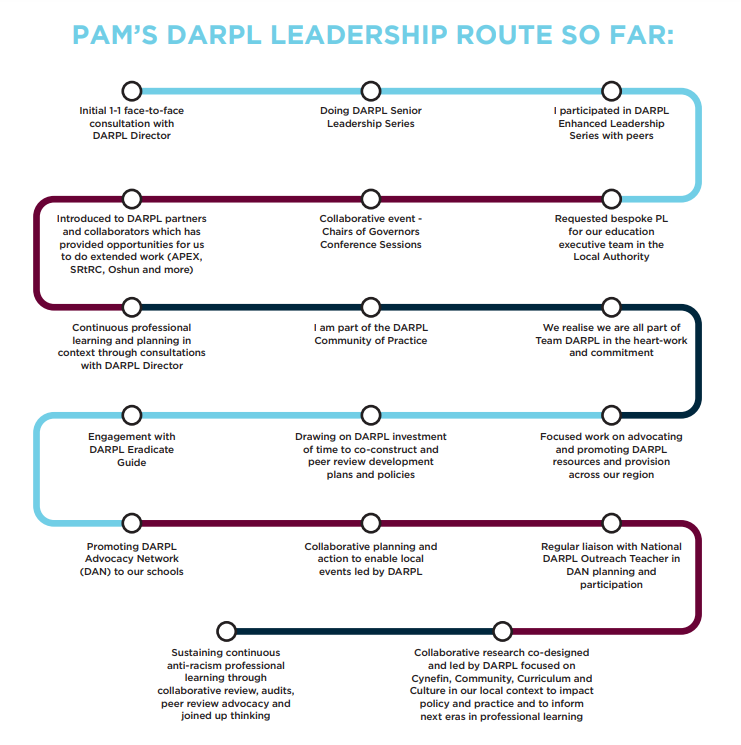
What do you think? What are you doing across your teams/area? Where have you visited so far on the DARPL Tube? https://darpl.org/wp-content/uploads/2024/10/DARPL_Tube_Map_SCHOOLS_ENG24.pdf