
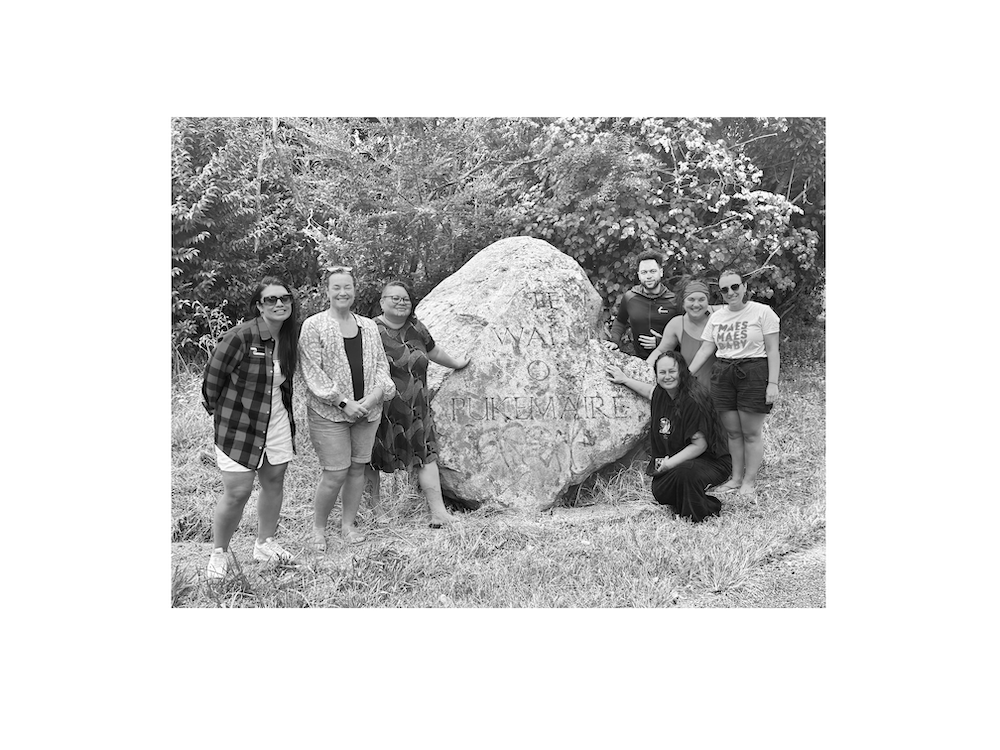
‘Taith’ funded Professional Learning Exchange Visit to Aotearoa (New Zealand)
Authors: Chantelle Haughton, Sian Smith and Amanda Williams
He rangi ta matawhaiti, he rangi ta matawhanui – An old Māori proverb suggests that a person with narrow vision has a restricted horizon; a person with wide vision has plentiful opportunities for growth in wisdom.
This blog is a triple patchwork piece of learning memories woven together to offer a glimpse into our time learning in the Māori world. We’re back from Aotearoa, to our own channels of work but still pondering collectively in the early stages of digestion amongst our learning and action planning within the opportunities it affords us. Our adopted professional learning whanau (family) will be visiting us in Wales in the summer 2024, we look forward to the next chapter. We also have a range of DARPL workshops and webinars this summer designed to discuss our thoughts with educators across Wales.
About Taith: In February 2024, five of us visited Aotearoa (Māori for New Zealand). Following Brexit, Welsh Government-funded Taith (Welsh for ‘journey’) initiative was launched in 2022, the enforced end of Erasmus, and the subsequent UK-wide ‘Turing’ programme only offering funding to one Welsh school in 2021. Taith is an international learning exchange programme established to create life-changing opportunities for people in Wales to learn, study and volunteer all over the world. The Taith programme has a clear commitment to reciprocity, funding both outward and inward ‘mobilities’. Our Taith Pathway 2 (international collaborative partnerships) visit involved five Welsh participants from three different institutions: Ysgol Gyfun Gymraeg Glantaf in Cardiff, Llanwern High School in Newport and Diversity and Anti-Racist Professional Learning (DARPL). The mix of Welsh and English medium, alongside DARPL was a well matched foci fit: we set out to see decolonised curricula presented in Aotearoa, and consider lessons for Welsh learning organisations in their journeys towards our anti-racist Wales 2030. We also wanted to understand approaches Te Reo Māori (Māori language) development for staff and pupils to see if they might be relevant to the Welsh language and appproaches to bilingualism in Wales.
Reflections from Chantelle: I feel it’s almost impossible to capture in short notes the learnings and emotions experienced so deeply, we packed the days and each one was defining, I’ve shared a little of it. The time gripped our hearts and minds as humans firstly for us to translate into our leadership in education.
The Underpinning: straight from the 27 hour flight, we drove up to Waitangi, we walked at 5am within the procession to the dawn ceremony to mark the signing of the Treaty of Waitangi in 1840, a poignant space for reflection on the treaty in Aotearoa now. Being surrounded by leaders in all definistions steeped in living history inhaling the emotions of pride, tension and aspiration for equity and leadership and the natural beauty of the Waitangi River and Bay of Islands was breathtaking. The fluidity and constant flipping and absortion of the Māori language mixed with English was captivating and inspiring. Waitangi Day set the tone for our learning ahead. We stood amongst people of all ages, the mix of calm, fury and hope was deeply palpable. Being immersed in this historic moment had us whirring in thought and feelings about synergetic issues, opportunities and challenges for Welsh and Māori learners. I pondered in my travel journal about how does this compare in experience, in belonging and in Cynefin for Minority Ethnic learners in Wales? Do all learners in Wales feel Welsh is ‘theirs’ to learn? If no / yes why? And what challenge and opportunity stems from that in Wales now? Our colleague Matthew Evans, Head teacher of Ysgol Gymraeg Glantaf shared his own insights and conversation snapshots about synergies in heritage and indigenous language he gained during Waitangi day in an article here.
Central point: I remember standing amongst learners at Manurewa High School in Auckland, my eyes tear-filled with joy and awe at their visible strength, confidence and knowledge in their heritage, their languages, their living culture showcased to us in ceremonial song and dance. Seeing their pride together in this way made my mother-heart boom. In converstaion with them later, they openly explained how in their school they build strength and cultural intelligence. They also openly shared about racist experiences they sometimes encounter in their wider city life. It made me think of my own sons, having similar experiences in Wales. The recent report (March, 2024) here from Children’s Commissioner, New Zealand outlines current critical issues with racism and stories similarly reported by our Children’s Commisioner in Wales (December, 2023) here.
The epitome: For meone of the biggest take-homes are thoughts to explore in my work in DARPL around cultural consciousness, cultural care and community wisdom – I think in our growing DARPL continuum and our developing wider-spanning models, we need to turn our attention to this even more. How much time do you really spend within your local and your Wales-wide communities positively absorbing ways of being, knowing and doing? Leon and I spent a day visiting the Marae (traditional Māori focal meeting place for communities) in Manurewa, we sang in Welsh as a duet in a Powhiri (welcome ceremony) and inhaled the bold and loving wisdom from elders and community leaders. In all the learning it also felt like a familiar space to me, the Tiger Bay girl felt at home. I particularly loved hearing the range of Māori vocabulary used to encompass community-family ways of being and emotions in knowing. There was a food bank, support facilities for health and all aspects of life, a barbershop academy and remarkable spiritual spaces for worship, celebration, wellness and sorrow.
Our colleague within our ‘Taith Whanau’ Heemi McDonald is a renowned leader in education. He has led significant work in collaborative learning steeped in community embrace, this involves two different subjects sharing a context, knowledge and skills to help deepen learners’ understanding within the curriculum. Thomas and McDonagh (2013, p46) believe that ‘It is the responsibility of the individual to ensure that they are understood in the way they intended’. Heemi explained that learning (especially in a collaborative environment) needs to have elements of a common language to allow individual learners to find success and connect their learning. Heemi’s approach is focused on cultural responsiveness and re-indigenising pedagogy beyond Western World views for all learners in the kura (school/learning gathering) ‘Mātauranga Māori is about a Māori way of being and engaging in the world – in its simplest form, it uses kawa (cultural practices) and tikanga (cultural principles) to critique, examine, analyse and understand the world’ (Kia Eke Panuku, 2016).
Within this example there are six learning modes designed to enable deeper understanding collectively and individually. I’m mindful I’ve oversimplified them here in this blog, but Heemi will talking about this in the DARPL National Leadership Conference in Llandudno in June 2024, I’ll be sure to learn more about it then. Heemi, explains it is important to understand that learning needs to sit holistically with the individual (takitahi) or the collective (kotahitanga). It hit straight to me DARPL heart when Heemi offered caution that collective (kotahitanga) learning experience cannot be overlooked, neglected or disregarded. This philosophy is central to how Māori approach life and I think something we need to consider a lot more in transferable consideration for in our work in Education in Wales.
- The Haututu: nurtures and embraces curiosity and creativity, active explorations, physical movements, testing, playing, challenging and leadership trials.
- The Mahinga: expects research and applied learning through doing across a range of contexts.
- The Whakapapa: provides opportunity for connectivity, sense of self, relationships, community, evaluations and reflection.
- The Kaimahi: enables working in togetherness, shared goals, communal purpose. Independence, motivation and tenacity are at the heart of this mode.
- The Hui: requires networking, sharing, role modelling, discussion, evaluation and mentoring.
- The Hapori: scaffolds and develops links to community and connectedness to local, national and global contexts. Attention is on community impact and contribution (away from but bridging into attainment/assessment).
This has inspired us in our work here to explore ‘pairing’ and much more. One initial exploratory example is an upcoming piece of work Amanda (in Ysgol Gymraeg Glantaf) and I (in DARPL and local community authentcity outreach) are heading into in Ysgol Gymraeg Glantaf (pairing music and science) in curricula development around reggae music, sound systems and carnival culture in Wales.
Reflections from Amanda: ‘We need Warrior Scholars: revolutionary young people who are secure in their own identity and language who are ready to go out and change the world.’ When I heard a headteacher at a school say this, it made me think – do we have Welsh ‘warrior scholars’?
Our two countries are similar in many ways: colonisers have systematically tried to eradicate our languages and cultures. The 1867 law passed in Aotearoa that decreed that only English was to be written or spoken in schools reminded me of the Welsh Not where Welsh children were beaten if caught speaking Welsh. While there are these clear similarities between the two languages, Welsh-speaking people have not faced the same racism and discrimination as the Māori people. Today, Aotearoa has a right-wing government that reinforces colonial ideologies – it is passing legislation to minimise the use of Māori in public spaces, whereas the Welsh government has set the ambitious target of having one million Welsh speakers by 2050 and a Welsh curriculum that gives us space to move away from colonial ideologies.
While we have a strong focus on Welsh language learning in Wales, what excited me the most in Aotearoa was how ‘te ao’ (Māori world view) and whakapapa (what it means to be Māori) is at the centre of the curriculum. At Kia Aroha School the curriculum is represented as a three-legged stool:
- Red lens: everything that is in the child’s DNA – culturally sustaining pedagogy, languages, celebrating who they are and their whakapapa.
- Green lens: our collective responsibility to contribute to anything bigger than ourselves – community service, representing the school / community, being a global citizen.
- Blue lens: mandated curriculum – reading, writing, maths.
Hailey explains that if one of those legs is smaller than the other or afforded less or more time, the stool will topple over. Whilst the new Curriculum for Wales encourages us to delve into the red and green lens more than we have done previously, the blue is certainly afforded much, much more time and awarded greater importance. Schools have always been assessed by how literate and numerate their students are, and these subjects traditionally have more time on the timetable. Parents often want to know about their children’s reading and maths abilities more than anything, and hire tutors if they are not making sufficient progress in these areas.
What if we put more emphasis on the red and green lens? This is not easy, as we have generations of teachers where the content of the curriculum has been dictated to them by the government. But now, with the curriculum for Wales, we have much more freedom to teach what is important to our students, true history and local culture. What if, rather than teaching Welsh as a language, we encouraged students to see the language as a part of their cultural identity, what it means to be Welsh, their ‘whakapapa’. I’m not talking about spending more time on language learning to check if something is a soft mutation or a nasal mutation (which also has its place) but Welsh being a part of their DNA, whether they were born in Wales or not, whether their parents speak it or not, whether they go to a Welsh medium School or not.
Teachers and parents regularly cite ‘it’s a useful skill in the job market’ as a reason for learning Welsh. What if instead we said: it’s a part of who you are, it’s a part of your history, your story. Isn’t that far more appealing for our Welsh children? What if we say, you’ll have a connection with people that speak indigenous languages all over the globe? It will give you a better understanding of the world? Surely that is a more inspiring call to action than ‘it will boost your CV’.
Reflections from Sian: Just over two decades ago, early in my career, I worked in a school in south Auckland and the experience has stayed with me: from the powhiri (welcoming ceremony) on our first day at the school at the marae (Māori meeting house) to still remembering the te reo Māori words to the school waiata (song) that we sang together in staff briefing every Monday and Friday. I also remember the tikanga (protocol) of the karakia (incantation) at the start of meetings to increase the likelihood of a favourable outcome. I remember learning about the Treaty of Waitangi (the agreement between the crown and Māori signed in 1840) and it being a focus in history lessons, and the sheer scale of Māori words and tikanga that I learned in such a short space of time, despite being in an English medium school and despite the language being classed as endangered by UNESCO. My previous experience in Aotearoa New Zealand also made our ‘outward mobility’ an informed visit; we were able to use connections to identify successful, effective and innovative ‘movers and shakers’ in te reo Māori provision and decolonised curricula. We even managed to secure a private audience with the world-renowned Māori academic, Linda Tuhiwai Smith who, as well as inspiring the group through her intersectional, reindigenising methodologies and activism, spoke fondly about her time in Wales, and the synergies between the Welsh and te reo Māori language development models.
What I learned from our taith was both expected and unexpected. I had predicted seeing:
- Experiential and authentic cultural practices that supported language learning.
- Code-switching of key words and concepts that merged Te Reo and English to make New Zealand English distinct from other ‘Englishes.
- Curricula that challenged colonial views across all subject areas that incorporated te ao Māori (the Māori world view).
We saw and heard all of the above and more, including decolonised, or more accurately reindigenised, school structures and ways of knowing and being, and those experiences will have a profound impact upon each of our individual and collective leadership in the future. However, the deeper, life-changing learning or ‘taith’ was unexpected. I did not expect to feel so moved by Te Reo Māori and the concepts behind the words and tikanga. I hadn’t realised how precarious te reo Māori’s future remains, how close to extinction it was in 1980, and that it was only in the 1985 when it was officially recognised as an official language of Aotearoa New Zealand thanks to activists such as Linda Tuhiwai Smith – finally seen a taonga (treasure) to be protected by the Treaty. This legislation came a whole 184 years after the Treaty was signed, and after 102 years of the Native Schools Act which explicitly banned te reo Māori being written or spoken. The impact of white settlers enacting an imagined ‘white nation’ for so long despite the Treaty is horrific, but I didn’t expect the impact that this history of language from the other side of the world would had on me, especially as a Welsh person who does not speak Welsh.
I grew up in Cardiff, within a Welsh family where not one of my living Welsh generations spoke Welsh. I went to English medium school and was intrigued by the language enough to choose it for A level, only to be disillusioned by the inordinate literature content. I have sent my own children to Welsh medium school, with the support of my English husband but with voiced cynicism from my in-laws and even, to lesser extent, my own family and friends. I have been challenged by the classic questions, nearly always from monoglot English speakers:
- Why would you want them to learn a dead language?
- Aren’t you bothered you won’t be able to help them/understand their work?
- Won’t it affect their English development?
- Won’t they struggle if they go to an English university?
And I have, over the years, responded with what I would consider the ‘classic’ Cardiff capitalist response around ‘wider opportunities if they stay in Wales’ and, on occasion, some discussion regarding the positive impact bi/multilingualism has on cognitive abilities. However, sometimes, if it was a proper conversation as opposed to a debate framed as one, I’d admit that I would have loved to have spoken Welsh fluently, was often embarrassed that I didn’t, and that I wanted my children to know the indigenous language of the country where they lived.
The regret at the multi-generational loss of my indigenous language became front and centre during the Taith visit. The way that Matthew Evans, as our spokesperson was able to respond yn Gymraeg during the Powhiri to Te Reo Māori instantly made a deep connection with all of the Māori pupils and staff. Fluency through two different indigenous, minority languages that live perilously close to English was all that was needed to create a cultural bond without necessitating translation. I had been starting to think about the English language as a colonial power tool as part of my MA study, but this thought was crystallised through my experiences in Aotearoa New Zealand and through listening to the Māori leaders whose parents had so recently been banned from speaking their own language.
And it’s more than losing your own indigenous language ability because languages are not interchangeable and the presence, absence and doubling up of vocabulary reveals so much about world views and culture. It would take far more than a couple of sentences in a blog to illustrate, but for a quick Welsh reference think ‘Cynefin’ and also think ‘dysgu’. The former has no direct English translation but has deep meaning in terms of cultural identity and belonging and holds status as the only Welsh word in the Curriculum for Wales. The latter can mean either, or both, teaching and learning. In this way, ‘Dysgu’ almost does the same as the Māori word ‘ako’ which similarly encapsulates both teaching and learning in one word. And, if you come at this from the colonised viewpoint that this is a ‘limitation’ of Cymraeg or of te reo Māori, you will miss the reciprocity, lack of hierarchy and deeper meaning of that magical, reciprocal process – sometimes teacher, sometimes learner. I was left with a renewed vow to return to Welsh language learning, and a burning desire to not only decolonise, but reindigenise the Welsh curriculum.
More Reflections from Amanda: Te ao (Māori world view) and whakapapa (Māori genealogy / what it means to be Māori) is at the heart of the curriculum in the schools we visited – their heritage and culture permeates every aspect of school life. It made me question, how often do Welsh students have an opportunity to connect and showcase their heritage in our schools?
Students live out their history every time they welcome someone new into their community in a pōwhiri (an ancient welcoming ceremony). As a part of the ceremony, Kapa Haka Group (traditional Māori performing arts group) perform traditional songs and the haka. Seeing secondary school aged students perform with such sincerity and reverence was an incredibly powerful and emotional experience. The words they were performing took over their entire body and faces. The stories of their ancestors came to life in their body and faces – we didn’t need to understand the words to appreciate their significance. In all the schools we visited, the haka was never a superficial performance, teenagers on a school day morning shook off their teenage self consciousness and showed us who they and their people were through words, song and dance. Their deep, intrinsic understanding of the tangata whenua (people of the land) and their place in it was striking.
After the Māori had welcomed us into the marae with Whaikōrero (formal speech) and waiata (song), guests were expected to reciprocate with the same. We watched students’ body language shift when they first heard the Welsh language and their eyes lit up when they heard our waiata (song, which was Calon Lan). Their curiosity about another indigenous language and culture was so clearly evident from their response. Their understanding of their own culture and their eagerness to learn about ours was further evident in the final bit of the ceremony – when we sit together for kai (food). They asked about the survival of our language and cultural practices. I asked one of the students about the haka they had performed – he said it was a story about ‘enemy tribe killing villagers’. I then asked how it felt to perform such a difficult story and he said ‘I cried a lot the first few times but now I’m used to it, it’s a part of who we are, it’s important.’ Another student talked about how the Māori culture was not strong in his home, but he felt like he belonged in the Kapa Haka group, and that connected him to his ancestors and his culture. Having an innate understanding of their own cultural identity enabled them to ask insightful and meaningful questions about other cultures.
We visited one school in their first week of term, but rehearsals were underway for Polyfest. Polyfest is an Auckland-based festival that showcases New Zealand’s diverse cultures and a celebration of youth performance. Students traditionally compete on six stages, performing traditional items from the following cultures – Cook Islands, Māori, Niue, Samoa, Tonga. We attended rehearsals for the Samoa and Tonga groups – both had a very different atmosphere but the same drive and determination to give the best performance at Polyfest. Whilst there was healthy competition and a lot of banter on who could give the best performance, there was also a deep respect, understanding and support for each other’s cultures.
Having whakapapa (what it means to be Māori) and Māori history at the center of all aspects of the curriculum and having the opportunity to showcase this in ‘everyday’ activities like the pōwhiri and special events such as Polyfest means that students are able to understand themselves and therefore better understand others around them. Events like this are in our school calendars already – I was recently inspired to see the students at my school put their hearts and souls into competitions at the School Eisteddfod. Student voice is essential to the success of such events – they need to reflect the heritage, culture and interests of the students. The success of the day was evident at the end where every single student sang the Welsh National Anthem at the top of their voices, the feeling of national pride was much like you see on the streets of Cardiff on match day. But how often do our students get to put their heritage, culture and identity in the center of their learning and their day to day life at school? And what does that mean for each and every one of our learners in Wales with the wonderful diversity they bring? The Curriculum for Wales gives us an opportunity to put our students’ whakapapa at the core of their everyday life. Giving the space to celebrate their own heritage and understand other cultures means we can ‘support our children and young people to be ethical, informed citizens of Wales and the world.’
If you’d like to discuss more about our learning in Aotearoa, please come along to the DARPL webinars / conference or contact us on DARPL@cardiffmet.ac.uk
References
Kia Eke Panuku, 2016 https://kep.org.nz/assets/resources/site/Voices7-16.Matauranga-Maori.pdf
Thomas, J., & McDonagh, D. (2013). Shared language: Towards more effective communication. The Australasian medical journal, 6(1), 46–54 54.